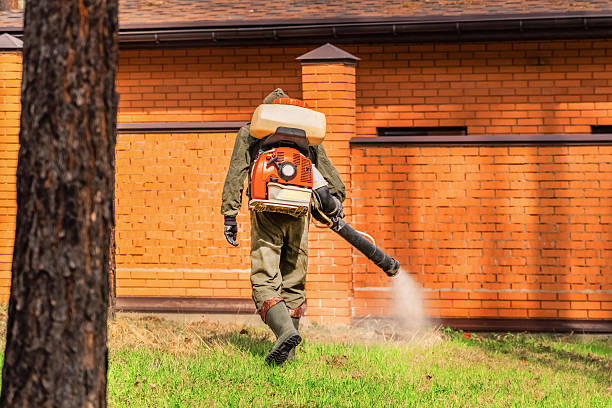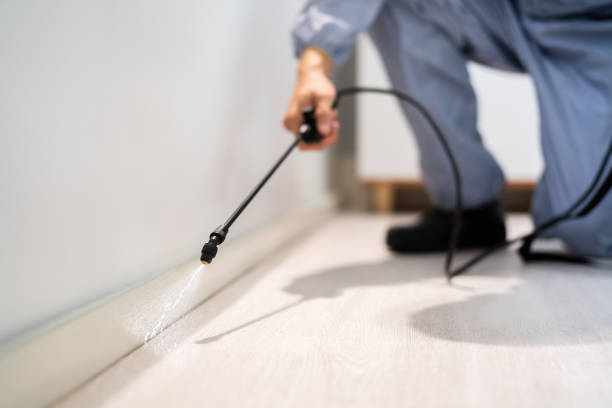
DIY spray aimed at a wasp nest from 10 feet away increases aggression and rarely eliminates the full population. Show Me Pest Control's technicians in Elsmere arrive with proper protective equipment, locate every nest on the property, and eliminate them in the correct sequence.
Protective protocol matched to the threat level of the specific nest type.
Before treating the nest you called about, we sweep the property for all others. Eaves, soffits, attic gable vents, tree branches, ground depressions near the foundation, hollow landscape features -- all checked before treatment begins. Finding the nests you did not know about is the most important part of the job.
Different nests require different protective approaches. A paper wasp nest under an eave is a low-to-moderate threat. A yellow jacket ground nest at your kids' play structure with 3,000+ workers is a different situation entirely. We match the protective protocol to the threat level.
When wasps are nesting inside a wall or attic, the entry point spray approach leaves the vast majority of the colony untreated. We access the void -- through the interior if necessary -- inject the correct product directly into the nest chamber, and seal the entry after the colony has been eliminated.
Treated nesting sites without a residual barrier become next year's nesting sites. We apply residual product to all treated locations -- eave surfaces, ground openings, former void entries -- so that returning queens cannot re-establish. The prevention step is what makes wasp removal last more than one season.
Paper wasps build open-comb nests visible to the naked eye -- small clusters of hexagonal cells attached to a surface by a single stalk. They are identifiable by their thin waist and long dangling legs in flight. They are not defensive at a distance and do not pursue -- the risk from paper wasp nests comes from proximity and direct physical contact with the nest or the immediate surrounding structure. Removal is straightforward with proper protective equipment. The priority is applying residual to the site after removal to prevent the following season's queen from re-establishing at the same location.
The behavioral profile of yellow jackets -- as opposed to paper wasps -- is the reason void nests and ground nests require professional treatment. A yellow jacket colony does not tolerate intrusion. The defensive response is proportional to colony size: a small early-season colony of a few hundred workers produces a manageable defense, while a late-summer colony of 4,000 or more produces a simultaneous attack by dozens of workers that can result in multiple stings before a person can retreat. DIY knockdown spray aimed at the entrance of a ground nest stimulates the colony's defensive response without delivering enough active ingredient to the interior to eliminate the population -- the result is an agitated colony that is now aware of a threat at its entrance, with hundreds of workers mobilized in defense and an undamaged nest interior.
Bald-faced hornets are a yellow jacket relative -- technically a wasp -- that builds the large, gray, papery football-shaped or teardrop-shaped nests visible in trees, attached to structures, and sometimes on utility poles or equipment. Despite their distinctive appearance, many people do not recognize bald-faced hornet nests and attempt to knock them down with a spray can from a short distance. This is consistently dangerous. Bald-faced hornets are highly aggressive within several feet of the nest and will pursue a perceived threat away from the nest site -- they do not limit their defensive response to the immediate nest perimeter the way paper wasps do. A large bald-faced hornet nest can contain 400 to 700 workers by late summer. Treatment requires approaching from a downwind angle at maximum application distance with appropriate protective equipment -- it is not a situation where proximity with a standard spray can is safe for an unprotected person.
Wasp nest near a doorway, play area, or pet area in Elsmere? Call +1-866-315-0243. We prioritize active stinging insect calls in Elsmere for same-day response.
The most problematic wasp situation from a DIY treatment standpoint is the void nest -- a yellow jacket colony established inside a wall void, soffit cavity, or attic space. Void nests are identified by a consistent entry point through a gap, crack, or opening in the exterior of the structure -- typically a wood joint, a gap in vinyl siding, or an opening around a pipe or conduit penetration. The number of workers entering and exiting the entry point is a reliable indicator of colony size and maturity. A large void nest may have a substantial buzzing sound audible from inside the adjacent room. Spraying the exterior entry point with consumer knockdown spray addresses only the guards at the entrance -- it does not reach the nest chamber inside the void, and it agitates the colony while leaving the population intact. The workers inside increase their defense activity, and the colony may begin exiting through secondary entry points deeper in the structure. The correct approach is void injection -- applying insecticide directly into the nest chamber through a small access point -- followed by sealing the primary entry after the colony is eliminated.
Fall is the appropriate window for preventive treatment at high-risk nesting sites -- eave boards where repeated nesting has occurred, attic gable vents with a history of yellow jacket activity, and ground nest entrance areas from the current season. Queens that mated in late summer overwinter in sheltered sites and re-establish nests in spring, showing strong fidelity to previous nesting locations. A residual product applied to former nesting sites in late fall -- after the colony has died or been eliminated -- deters new queen establishment in spring when queens begin scouting for nesting locations. This preventive application is especially effective for properties that deal with recurring annual nest establishment at the same location, which is a consistent pattern when the post-season residual is not applied. The cost of preventive fall treatment is a fraction of the cost of reactive season treatment.

We prioritize active stinging insect calls. Same-day service available in Elsmere and surrounding Elsmere, DE areas.
Call +1-866-315-0243From initial property sweep to preventive fall application -- the complete stinging insect protocol in Elsmere.

We sweep the full property before treating any individual nest -- all eave lines, soffits, gable ends, tree branches, ground areas, wood pile edges, and landscape features. Secondary nests are found and treated the same visit.
Open-comb paper wasp nest removal from eaves, window frames, door frames, porch ceilings, and fence structures. Residual applied to the nesting site after removal to prevent next season's queen from re-establishing.
Ground nest treatment with full protective gear, correct product application to the nest interior, and entrance sealing to prevent reuse.
Gray enclosed paper nest treatment with maximum application distance and full protective equipment. Bald-faced hornets are highly aggressive near the nest -- safe treatment requires distance and protocol that consumer products cannot provide safely.
Void injection, entry sealing, and structural assessment -- the complete protocol for wall and attic yellow jacket colonies.
Preventive fall treatment is the most cost-effective protection against recurring annual nesting at known sites.
The four steps that produce complete elimination -- not partial knockdown.
Phone assessment establishes the nest type and urgency. We confirm dispatch before you hang up.
No technician is dispatched without full protective gear for the threat level involved. The equipment arrives with the technician.
We find all of them. The nest you called about and the ones you did not know about are both on the treatment list.
All nests treated, all sites residual-treated. Documentation left on-site. Follow-up timing confirmed.
Three different nest types, three different protocols, three problems solved.
Ground nest 4 feet from the play area, Sunday morning. Show Me Pest Control answered, confirmed arrival by early afternoon. Property sweep found two more nests on the garage I had walked past multiple times. All three handled in one visit. The sweep was the part I did not expect -- most companies just treat what you call about.
Attempted to spray what I thought was a wasp nest. Got stung 11 times before I got back inside. Show Me Pest Control identified it as bald-faced hornets -- a completely different threat level than I understood. Treated correctly. Inactive within 15 minutes. I had no idea there was such a difference between nest types until this happened.
The soffit spray was not working and the contractor could not explain why. Show Me Pest Control confirmed a void nest the moment they looked in the attic. Treated directly, sealed the entry. First season without stings at the entrance in two years.
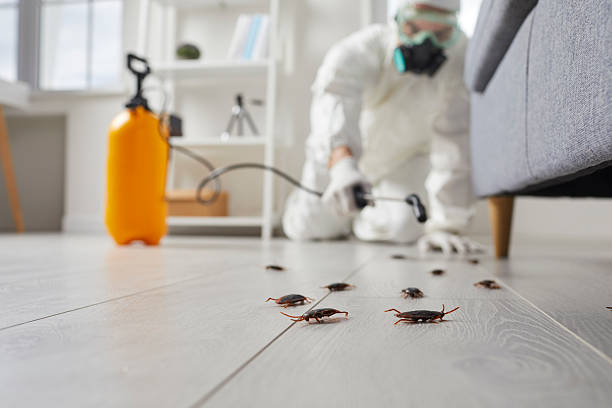
Same-day wasp removal in Elsmere. Call and we confirm arrival before you hang up. Full property nest sweep included on every visit.
Call +1-866-315-0243 -- Same Day